Showing posts with label CARS. Show all posts

Saturday, 6 June 2015

The fastest police cars in history

Crime doesn't pay: The fastest police cars in history

Here at Classic Driver, we’re all for law and order – but when the police are equipped with these potent machines, it does seem a little unfair on Burglar Bill.

France: Renault Alpine A110

Crime doesn't pay: The fastest police cars in history
Even if the films of Louis de Funès suggest otherwise, the French Gendarmerie of the 1960s pursued not only nude swimmers on the beaches of Côte d'Azur, but also speeding motorists. In 1966, the ‘Brigade’ acquired their first Alpine A110, allowing them to keep pace with even the fastest Italian sports cars through the switchbacks.

England: Triumph TR4

Crime doesn't pay: The fastest police cars in historyCrime doesn't pay: The fastest police cars in historyCrime doesn't pay: The fastest police cars in history
The English Police Force was also appropriately equipped to deal with those breaching the speed limits – but we suspect its selection of squad cars went beyond the altruistic. In 1962, Southend-on-Sea’s law enforcement officers were equipped with several Triumph TR4 convertibles, a car more than capable of reeling in bank robbers in their Jaguar saloons. The Triumph proved popular and remained in service for some time – and the open configuration allowed even the tallest constables to retain their helmets in anticipation of a foot chase.

Germany: Porsche 911 Carrera

Crime doesn't pay: The fastest police cars in history
German law enforcement recognised the merits of its domestic car industry as early as the 1950s, and soon put a fleet of 356s into Highway Patrol service. Subsequently, the protective powers adopted the 911 as a pursuit vehicle: the mid-90s saw Southern Germany’s officers equipped with near-170mph capabilities, courtesy of this liveried 282bhp 993.

Netherlands: Spyker C8 Spyder

Crime doesn't pay: The fastest police cars in history
With a top speed of 186mph, the 400bhp Spyker used by the Dutch Police Department would have had few worthy adversaries. Unfortunately, it only remained in police livery for a single outing, its purpose being as a promotional tool rather than a pursuing one – Dutch Ferrari owners can now return to a relaxed state.

Italy: Lamborghini Gallardo

Crime doesn't pay: The fastest police cars in history
Because Lamborghini doesn’t have its own test track, since the 1960s it has tested its new cars on the highways surrounding its Sant'Agata headquarters. Therefore, a good rapport with the local police makes sense – and 2005 saw the Italian marque famously present a pair of Gallardos to the force. Officially, they’re used for duties such as urgent organ transport, but we’re sure the officers have conducted their own ‘testing’ at some point.

Dubai: Aston Martin One-77, Lamborghini Aventador, Ferrari FF...

Crime doesn't pay: The fastest police cars in history
Other countries, other customs. With so many high-end supercars on the roads of Dubai, the police force needed to upgrade just to keep up. Its fleet – already containing a Mercedes SLS, a Ferrari FF and a Lamborghini Aventador – was recently strengthened with a Bugatti Veyron and Aston Martin One-77, if these pictures are to be believed.

Ford Mustang History

Ford Mustang History – Discover The Pony Car’s Origins And More

64_MustangConvertible
Do you know anything about the Ford Mustang history? This pony car has been around since the 60’s and is still selling well today.
The iconic Ford Mustang is an American automobile manufactured by the Ford Motor Company. It was initially based on the second generation Ford Falcon compact car and first introduced on April 17th, 1964. Within one year the Mustang became Ford’s most successful launch since the Model A.
The Ford Mustang led the way for a new breed of muscle car called “pony car” and gave rise to competitors such as GM’s Chevrolet Camaro, AMC’s Javelin, and Chrysler’s revamped Plymouth Barracuda.
Today the Mustang is still going strong and is Ford’s third oldest nameplate currently in production next to the F-Series pickup truck line and the Falcon that is still in production in Australia.

Ford Mustang History

Ford Mustang History - Discover The Pony Car's Origins And More
Production of the 1965 Mustang began in Dearborn, Michigan on March 9th, 1964 and the car was introduced to the public on April 17th, 1964 at the New York World’s Fair.
Executive stylist Pres Harris, who was a fan of the World War II P-51 Mustang fighter plane, is believed by many to have suggested the name and designed the body. An alternative view was that Robert J. Eggert, Ford Division market research manager, first suggested the Mustang name.
Eggert, a breeder of quarter horses, received a birthday present from his wife of the book, The Mustangs by J. Frank Dobie in 1960. Later, the book’s title gave him the idea of adding the “Mustang” name to Ford’s new concept car.
The name could not be used in Germany, because it was owned by Krupp, which had manufactured trucks between 1951 and 1964 with the name Mustang. Ford refused to buy the name for about USD$10,000 from Krupp at the time, so Mustang was sold in Germany as the “T-5″ until December 1978.
The Mustang has seen several different platform generations and designs. Although some other pony cars have seen a revival, the Mustang is the only original pony car to remain in uninterrupted production over the four decades of its production.

First generation Mustang (1964–1973)

1964-mustang
As Lee Iacocca’s assistant general manager and chief engineer, Donald N. Frey was the head engineer for the Mustang project, supervising the overall development of the Mustang in a record 18 months while Iacocca himself championed the project as Ford Division general manager.
The Mustang prototype was a two-seater, mid-mounted engine roadster. This vehicle employed a Taunus (Ford Germany) V4 engine and was very similar in appearance to the much later Pontiac Fiero.
It was claimed that the decision to abandon the two-seater design was in part due to the low sales experienced with the 2-seater 1955 Thunderbird and so to broaden market appeal it was remodeled as a four-seater coupe.
A “Fastback 2+2″ model traded the conventional trunk space for increased interior volume as well as giving exterior lines similar to those of the second series of the Corvette Sting Ray and European sports cars such as the Jaguar E-Type.
The new design was styled under the direction of Project Design Chief Joe Oros and his team which included L. David Ash, Gale Halderman, and John Foster. The final design was chosen at Ford’s Lincoln Mercury Division design studios where Iacocca instigated a design contest for the model.
64_Mustang
Having set the design standards for the Mustang, Oros said:“I told the team that I wanted the car to appeal to women, but I wanted men to desire it, too. I wanted a Ferrari-like front end, the motif centered on the front, something heavy-looking like a Maserati, but, please, not a trident and I wanted air intakes on the side to cool the rear brakes. I said it should be as sporty as possible and look like it was related to European design.”
Oros also added: “I then called a meeting with all the Ford studio designers. We talked about the sporty car for most of that afternoon, setting parameters for what it should look like and what it should not look like by making lists on a large pad, a technique I adapted from the management seminar.
We taped the lists up all around the studio to keep ourselves on track. We also had photographs of all the previous sporty cars that had been done in the Corporate Advanced studio as a guide to themes or ideas that were tired or not acceptable to management.
Within a week we had hammered out a new design. We cut templates and fitted them to the clay model that had been started. We cut right into it, adding or deleting clay to accommodate our new theme, so it wasn’t like starting all over. But we knew Lincoln-Mercury would have two models.
And Advanced would have five, some they had previously shown and modified, plus a couple extras. But we would only have one model because Ford studio had a production schedule for a good many facelifts and other projects. We couldn’t afford the manpower, but we made up for lost time by working around the clock so our model would be ready for the management review.”
1964-mustang1-500x375
Favorable publicity articles appeared in 2,600 newspapers the next morning, the day the car was “officially” revealed. A Mustang also appeared in the James Bond film Goldfinger in September 1964, the first time the car was used in a movie.
To cut down the development cost and achieve a suggested retail price of US$2,368, the Mustang was based heavily on familiar yet simple components, many of which were already in production for other Ford models.
Most of the interior, chassis, suspension, and drivetrain components were derived from those used on the Ford Falcon and Fairlane. This use of common components also shortened the learning curve for assembly and repair workers, while at the same time allowing dealers to pick up the Mustang without also having to spend massive amounts of money on spare parts inventories to support the new car line.
Original sales forecasts projected less than 100,000 units for the first year. This mark was surpassed in three months from rollout. Another 318,000 were sold during the first model year and in its first eighteen months, more than one million Mustangs were built. All of these were VIN-identified as 1965 models.
64_Mustang-engine
Many changes were made at the traditional opening of the new model year, including the addition of back-up lights on some models, the introduction of alternators to replace generators, and an upgrade of the V8 engine from 260 cu in (4.3 l) to 289 cu in (4.7 l) displacement.
Some six-cylinder Mustangs were fitted with the 101 hp, 2.8 liter Falcon engine, the rush into production included some unusual quirks, such as a horn ring bearing the ‘Ford Falcon’ logo beneath a trim ring emblazoned with ‘Ford Mustang.’ These characteristics made enough difference to warrant designation of the 121,538 earlier ones as “1964½” model-year Mustangs, a distinction that has endured with enthusiasts.
All of the features added to the “1965″ model were available as options or developmental modifications to the “1964½” model, which in some cases led to “mix-and-match” confusion as Ford exec, hurriedly ramped up production by taking over lines originally intended for other car models.
Some cars with 289 engines which were not given the chrome fender badges denoting the larger engine, and more than one car left the plant with cutouts for back-up lights but no lights nor the later wiring harness needed to operate them. While these would today be additional-value collectors’ items, most of these oddities were corrected at the dealer level, sometimes only after buyers had noticed them.

Second generation Mustang(1974–1978)

second-gen-mustang-500x402
Lee Iacocca, who had been one of the forces behind the original Mustang, became President of Ford Motor Company in 1970 and ordered a smaller, more fuel-efficient Mustang for 1974. Initially it was to be based on the Ford Maverick, but ultimately was based on the Ford Pinto subcompact.
The new model, called the “Mustang II, was introduced two months before the first 1973 oil crisis, and its reduced size allowed it to compete against imported sports coupés such as the Japanese Toyota Celica and the European Ford Capri. First-year sales were 385,993 cars, compared with the original Mustang’s twelve-month sales record of 418,812.
1976-mustangii
Lee Iacocca wanted the new car’s, shape and overall styling to be finished to a high standard, saying it should be “a little jewel.” However not only was it smaller than the original car, but it was also heavier, owing to the addition of equipment needed to meet new U.S. emission and safety regulations.
Performance was also reduced, and despite the car’s new handling and engineering features the galloping mustang emblem “became a less muscular steed that seemed to be cantering.”
The car was available in both coupé and hatchback versions. Changes introduced in 1975 included reinstatement of the 302 CID V8 engine option (called the “5.0 L” although its capacity was 4.94 L) and availability of an economy option called the “MPG Stallion”. Other changes in appearance and performance came with a “Cobra II” version in 1976 and a “King Cobra” in 1978.

Third generation (1979–1993)

3rd-gen-mustang
The 1979 Mustang was based on the larger platform (initially developed for the 1978 Ford Fairmont and Mercury Zephyr). The interior was restyled to accommodate four people in comfort despite a smaller rear seat. The trunk was larger, as was the engine bay, for easier service access.
Again the Mustang was available in two body styles, a coupé, and a hatchback. In 1983 a convertible model became available. Available trim levels included L, GL, GLX, LX, GT, Turbo GT, SVO (1984–86), Cobra, and Cobra R (1993).
80s-Mustang
In 1979 the Mustang served as an Indianapolis 500 pace car and to commemorate Ford built 10,478 replicas.
The 1982 models had the option of a 5.0 liter V8 engine instead of the 4.2 liter V8.
1983 was the first year for a 5-speed transmission.
During the 1980′s fuel prices escalated and sales slumped and in response to this Ford started developing a new Mustang variant based on Mazda MX-6 assembled at AutoAlliance International in Flat Rock, Michigan.
The new model was being designed as a front-wheel drive, Japanese-designed Mustang without a V8 option. Outraged Enthusiasts protested to Ford and so the new 1987 Mustang only received a major facelift while the MX-6 variant became the 1989 Ford Probe.
roushmustang-500x464
The 1984 to 1986 model years included the Mustang SVO featuring a 2.3 L Multi-port fuel injected, turbo charged inline 4-cylinder engine with an air-to-air intercooler. other unique features included, the return of Mustang 5-lug wheels, lower front forged control arms from the Lincoln Mark Series and was the first Mustang with four-wheel ventilated disc brakes, dual-wing rear spoiler, quad shocks on the rear axle, adjustable “Koni” gas struts and shocks, and other special parts.
Engine output in 1984 was 175 hp but was upgraded to 205 hp by the 1986 model year.
The 1985 model year received a new roller cam block, roller cam, and roller lifters.
1986 was the first year of fuel injection, excepting the SVO in 1984-1986.

Fourth generation (1994–2004)

1994FordMustangGT-500x333
In 1994 the Mustang underwent its first major redesign in fifteen years. Code-named “SN-95″ by the automaker, it was based on an updated version of the rear-wheel drive Fox platform called “Fox-4.” The new styling by Patrick Schiavone incorporated several styling cues from earlier Mustangs and for the first time since 1973, a hatchback coupe model was unavailable.
The base model came with a 3.8 OHV V6 engine rated at 145 bhp and was mated to a standard 5-speed manual transmission or optional 4-speed automatic. Though initially used in the 1994 and 1995 Mustang GT, Ford retired the 302 cid pushrod small-block V8 after nearly 40 years of use, replacing it with the newer Modular 4.6 L (281 cid) SOHC V8 in the 1996 Mustang GT. The 4.6 L V8 was initially rated at 215 bhp but was later increased to 225 bhp (168 kW) in 1998.
1994MustangGTConvertible02-500x302
For 1999, the Mustang received Ford’s New Edge styling theme with sharper contours, larger wheel arches, and creases in its bodywork, but its basic proportions, interior design, and chassis remained the same as the previous model.
The Mustang’s powertrains were carried over for 1999, but benefited from new improvements. The standard 3.8 L V6 had a new split-port induction system, and was rated at 190 bhp (140 kW) while the Mustang GT’s 4.6 L V8 saw an increase in output to 260 bhp (190 kW) thanks to a new head design and other enhancements.
There were also three alternate models offered in this generation: the 2001 Bullitt, the 2003 and 2004 Mach 1, as well as the 305 bhp, 320 bhp and 390 bhp Cobra.

Fifth generation (2005-present)

yellow_2005_mustang_gt-500x327
At the 2004 North American International Auto Show, Ford introduced a completely redesigned Mustang, codenamed “S-197,” that was based on an all-new D2C platform. Developed under the direction of Chief Engineer Hau Thai-Tang and exterior styling designer Sid Ramnarace, the fifth-generation Mustang’s styling echoes the fastback Mustangs of the late 1960s. Ford’s senior vice president of design, J Mays, called it “retro-futurism.”
The fifth-generation Mustang is manufactured at the AutoAlliance International plant in Flat Rock, Michigan. The base model is powered by a 210 hp (157 kW) cast-iron block 4.0 L SOHC V6 that replaced the 3.8 L pushrod V6 used previously. The Mustang GT used an aluminum block 4.6 L SOHC 3-valve Modular V8 with variable camshaft timing (VCT) that produces 300 hp (224 kW).
2005_ford_mustang_GT500x375
The base Mustang came with a Tremec T-5 5-speed manual transmission while Ford’s own 5R55S 5-speed automatic was optional. The Mustang GT featured the same automatic transmission as the V6 model, but manual was a heavier duty Tremec TR-3650 5-speed.
Ford announced in July 2007 that all 2008 Mustangs would have seats containing material derived from soybeans.
2007mustang_interior
A new option for the 2009 Mustang was the glass roof. This $1,995 option is in effect a full roof sunroof that splits the difference in price and purpose of the coupe and convertible models.
The redesigned 2010 model year Mustang was released in the spring of 2009. It continued on the D2C platform and most of the previous-year’s drivetrain options. The exterior was revised with only the roof panel being retained achieving a drag reduction of 4% on V6 models and 7% on the GT models.
2010-mustang-500x300
The V6 for base Mustangs remained unchanged, while the Mustang GT’s 4.6 L V8 was revised to specifications similar to that of the 2008–2009 Mustang Bullitt’s 4.6 L V8, resulting in 315 hp (235 kW) at 6000 rpm and 325 lb·ft of torque at 4250 rpm.
Other mechanical features included new spring rates and dampers to improve ride quality and control, standard traction control system and stability control system on all models, and new wheel sizes.
For 2011 Ford has revised all the Mustang’s engines. The new V6 is a smaller 3.7 L (227 cu. in.) aluminum block engine weighing 40 lb (18 kg) lighter than the outgoing version. The engine produces 305 hp (227 kW) and 280 lb·ft (380 N·m) of torque. Ford announced on December 28, 2009 that the 2011 Mustang GT would feature a 5.0 engine that produces 412 horsepower.
2011-Ford-Mustang-GT-3-500x335
The new Ford 5.0-liter V8 “Coyote” engine has a 32-valves with Twin Independent Variable Cam Timing (TiVCT). These cams control intake and exhaust functions of the vehicle to maximize combustion.
The transmission includes either a 6-speed automatic or manual. An Electronic Power Assist Steering (EPAS) removes the conventional hydraulic power steering pump so now the system no longer requires belts previously used to assist the steering.
An optional Brembo brake upgrade is available. These brakes were previously used on the Shelby GT-500. A pair of 19-inch wheels and performance tires is included.
The Shelby GT500′s 5.4 L block is now made out of aluminum making it 102 lb (46 kg) lighter that the iron units in previous years, and is now rated at 550 hp (410 kW) and 510 lb·ft of torque.

Ford Mustang Awards

2005_mustang_car_of_the_year_award-500x375
The 1965 Mustang won the Tiffany Gold Medal for excellence in American design, the first automobile ever to do so.
The Mustang was on the Car and Driver “Ten Best list” in 1983, 1987, 1988, 2005, and 2006. It won the Motor Trend Car of the Year award in 1974 and 1994.
In 2005 it was runner-up to the Chrysler 300 for the North American Car of the Year award and was named Canadian Car of the Year.
****
The Mustang has many more years to go and many more models to enter the Ford Mustang history books.

A History of Concept Cars

A History of Concept Cars


Following our recent article on today’s concept cars and designers, Gijsbert-Paul Berk begins a new series of historical articles that will convey the history of dream and show cars and examine which concept cars or design studies influenced the shapes of our automobiles. Below, three interesting and legendary fashions that helped set styling trends.
By Gijsbert-Paul Berk
Breaking Away
Concept cars, dream cars, or show cars by any name are not by any means new. Historically, dream cars are outrageous, crowd-pleasers and often trend-setters. The story of the dream car begins in 1896 as the French made a concentrated effort to make the new motor car look less like ‘horseless carriages’. In general, the design and construction of automobile bodies was the work of coachbuilders, who only a few years before, had built the horse-drawn carriages. This similarity sometimes caused confusion and irritated a number of people.
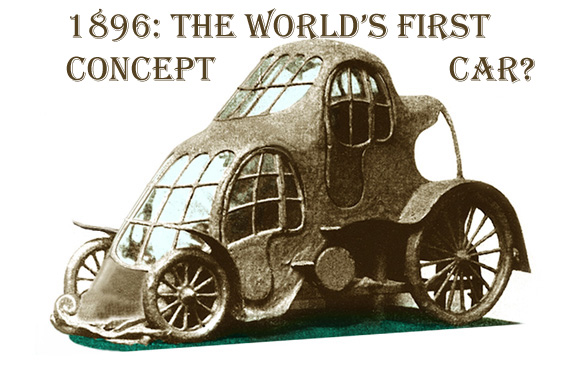
This was one of the reasons why the well-known Parisian department store “Le Louvre” organized a competition for ideas for the coachwork of ‘modern’ motor cars in 1896. The contest was open to all kinds of artists such as painters and sculptors but also to architects and coachbuilders. The prizewinning entry was a scale model made from wax, cardboard and glass by Pierre Selmersheim, an architect and furniture designer. As can be seen from the competition, the Selmersheim design was fairly radical and advanced for the era. A photo of it was widely publicized in the French newspapers and European motoring magazines. But none of the many French coachbuilders was interested in building it.


These drawings are additional entries in the competition. It is easy to see why the Selmersheim design in the lead photo above, won.
During the early years of the motor car, it was customary that a chassis be brought to a coachbuilder to be fitted with its body, and the coachbuilders together with his client determined the styling fashion. Some of these coachbuilders created new trends or concepts which, with hindsight, can be considered as milestones in the evolution of automobile design. Because as they presented their latest creations at Motor Shows and Concours d’Elegance, these new trends got attention in the Motoring Press and were often copied by their colleagues and competitors. Thus most of the first ‘concept cars’ can be attributed to coachbuilders.
Four Forward
In 1902, a new style of open coachwork emerged in Europe. Initially called a ‘Tonneau de Grand Luxe’, it became more popularly known as the ‘Roi-des-Belges’ (King of the Belgians) body style. Its main characteristics: four well-upholstered seats, all viewing forward, to offer more comfort to the passengers. The design was the idea of the mistress of King Leopold.
Cleo in 1903.
The story is legendary but perhaps not all what it seems. As far as possible, we will try to set the record straight.
In August 1901 King Leopold of Belgium visited Paris. There, His Majesty met Fernand Charles, a designer for the coachbuilder De Rothschild & Fils. He invited Charles to the apartment of his friend Madame Cléo de Mérode where they could discuss the design of a body for a new Mercedes chassis he had bought. Cléo de Mérode was very beautiful, quite famous as the ‘première danseuse’ (prima ballerina) of the ballet of the Opéra in Paris and supposedly was the ‘amie intime’ of King Leopold II, who was almost 40 years her senior.
During their discussion, Madame de Mérode put two of the richly upholstered tub armchairs in the apartment next to each other, and suggested similar seats should be placed in the rear portion of the new body, both facing forwards.
At that time the tonneau bodies generally had two benches facing one another in the rear compartment (some, like the De Dietrich, had bench seats both facing forward). The King was captivated by the idea of his beautiful companion and ordered Charles to make some drawings, and in particular to copy the lines of backrests of the tulip-shaped chairs. In September 1901, His Majesty approved the design and instructed Charles to supervise its construction at De Rothschild & Fils. The car was delivered in April 1902. Its body was made of aluminum and a new lightweight alloy, called partinium. This was a new composition of aluminum and tungsten, developed and manufactured by Monsieur Henry Partin and also used in Jenatzy’s record-setting La Jamais Contente.
However, the dates and descriptions slightly differ from those found in the magazine articles from that era.
In its issue of April 20th 1901, The Autocar published a drawing of the new car for King Leopold, as delivered to him in Nice. “The body is of hammered aluminum, painted red, the frame being painted in Royal blue. The front splashers are of a new type, to so far as possible reduce the windage on the wings.” The car was equipped with wide and richly upholstered seats in red morocco leather. The left front seat was made extra wide to accommodate the King in comfort.

Alas, the illustration above shows clearly, that it did not have tulip-shaped rear panels. Secondly it was obviously a Tonneau with a rear entrance, and the chassis was not a Mercedes but a Panhard & Levassor.
Furthermore, the The Autocar of November 8th, 1902 carried this small but sad item: “It has been rumored that the King of the Belgians, had been ordered to cease motoring by his physicians. But however this may be, it is a fact that His majesty has just purchased three new cars. One is a Mercedes, which will be completed throughout at Cannstadt, and the other two are Mors cars, the bodies for which will be built in Paris”.
Then in June 1903, Car Illustrated published a photo of the fire damage at the Cannstadt factory and the ruins of the 90 HP Mercedes for the Belgium King.
Meanwhile in Car of June 4 1902, a Mr. Hugh Weguelin wrote that he was the original inventor of the modern Tonneau, as he had sent a drawing of such a body to Mr. Auscher of Rothschild & Fils, but failed to register it. He also mentioned that a few years earlier he had bought a high-backed Tonneau, designed by the Count de Périgord.
These amendments in no way diminish the historic value of what was one of the first bodies to be specifically designed for an automobile and ordered by a reigning Sovereign. As King Leopold II was already 65 years old in 1900 it is quite understandable that Mme. de Mérode insisted on the use of high-backed, thickly padded chairs, like those she had in her apartment. It is an endearing thought that she wanted her Royal friend to enjoy similar comfort in his new car.
One of the first Rolls-Royce Silver Ghosts that successfully participated in the 1907 Scottish Reliability Trial had a Roi-des- Belges body made by the British coachbuilder Barker & Co. This car is now considered to be the most valuable Rolls-Royce in the world, valued at USD 57 million.
At De Rothschild & Fils they must have been grateful to her, because this made their coachwork visually stand out from other Tonneau bodies. The Roi-des-Belges style set a new standard for comfort and was indeed a milestone in the evolution of body design and, like today’s concept cars, it attracted a lot of publicity.
Boat-like Cars

Period photo and drawing of the first door-less Labourdette Skiff on a 2.1 liter Panhard & Levassor X19 chassis. Unfortunatly, the nice girl in the photo gave no demonstration how to get in or out of the car.
Over the years body designers and stylists have often been inspired by other means of transport, such as boats, airplanes, steam locomotives and spacecraft.
The French coachbuilder Jean-Henri Labourdette in 1912 launched a revolutionary new coachwork concept. The passenger compartment of his open torpedo body was built in the same way as the fast rowing boats, known as skiffs. Although at that time wooden bodies were not rare, this was a totally new approach in automobile coachwork construction.
This design was in fact an idea of the Chevalier René de Knyff, a well-known sportsman and a prominent figure in French society.
In 1912 de Knyff asked Jean-Henri Labourdette to build a new body. “I want a very, very light but comfortable torpedo offering the least wind resistance. You know that I enjoy rowing. Why don’t you build this body like my skiff, in mahogany and with thin rafters? It’s light and strong,” said De Knyff.
In full color, the Labourdette Skiff was impressive and sleek...the perfect dream car.
When Labourdette told him that these skiffs owed their rigidity to the fact that boats had no doors, de Knyff said, “Then build me a torpedo without doors”.
“But how will you get in?” Labourdette objected.
“One will step over the sides.”
“And the ladies?”
“Well, they will also step over. We will finally see their legs,” he laughed.
Construction detail of Labourdette's Skiff with the wooden rafters, ribs and the diagonal overlapping planking. The rear part of the cab, above the waistline, was made from one piece of Australian wattle wood that was formed by heating.
To acquire expertise Labourdette went to the naval yard of Despujols on the Ile de Jatte. “According to what I had seen there, I constructed the skiff body with triple overlapping layers of mahogany planking, riveted on a frame of ash. Between the second and third plies I placed a layer of canvas, to increase the rigidity. Since it was almost impossible to sketch the shape for the rear of the body, I decided to model it. This was, I think, the first time, that an automobile body form was studied, by modeling it in wax”.
The whole body, including four aluminum mudguards, windscreen and seats weighed only 180 kg. The Panhard-Levassor with the Labourdette Skiff body attracted huge crowds at the 1912 Paris Motor show.
Unfortunately getting in or out a skiff-bodied car was indeed rather a problem for the ladies. The fashion in those days prescribed wearing dresses and skirts covering the ankles. Most ladies refused to lift their skirts and show their legs to climb in a car, especially in the case of the wives and/or girlfriends of the wealthy men who could afford such a car. So this coachwork did not attract many buyers. Consequently later skiff’s had doors.
A Labourdette Skiff body (with two small doors!) on a 1912 Mercedes 37/90 HP chassis, powered by a four-cylinder engine of 9.5 liters that was designed by Paul Daimler. It produced about 60 HP at between 1100 and 1300 rpm. For this model Mercedes still used chain drive.
SOURCES:
InFrom Veteran to Vintage One of the authors is Laurence Pomeroy, also technical editor of the British car magazine The Motorand a respected and serious journalist. In the book Pomeroy quoted the pioneer motorist and amateur body designer Montague Grahame-White, who during early 20th century knew everybody in the inner circles of the French and British motor trade. He also wrote the entertaining book At the Wheel; Ashore and Afloat.

Benz Patent Motor Car, the first automobile (The birth of the automobile

The birth of the automobile
Benz Patent Motor Car, the first automobile (1885 – 1886)
The first stationary gasoline engine developed by Carl Benz was a one-cylinder two-stroke unit which ran for the first time on New Year’s Eve 1879. Benz had so much commercial success with this engine that he was able to devote more time to his dream of creating a lightweight car powered by a gasoline engine, in which the chassis and engine formed a single unit.
   Enlarge
Benz Patent Motor Car, 1886
The major features of the two-seater vehicle, which was completed in 1885, were the compact high-speed single-cylinder four-stroke engine installed horizontally at the rear, the tubular steel frame, the differential and three wire-spoked wheels. The engine output was 0.75 hp (0.55 kW). Details included an automatic intake slide, a controlled exhaust valve, high-voltage electrical vibrator ignition with spark plug, and water/thermo siphon evaporation cooling.
On January 29, 1886, Benz applied for a patent for his “vehicle powered by a gas engine.” The patent – number 37435 – may be regarded as the birth certificate of the automobile. In July 1886 the newspapers reported on the first public outing of the three-wheeled Benz Patent Motor Car, model no. 1.
Long-distance journey by Bertha Benz (1888)
   Enlarge
Bertha Benz and her sons Eugen and Richard during their long-distance journey in August 1888 with the Benz Patent Motor Car.
Using an improved version and without her husband’s knowledge, Benz’s wife Bertha and their two sons Eugen (15) and Richard (14) embarked on the first long-distance journey in automotive history on an August day in 1888. The route included a few detours and took them from Mannheim to Pforzheim, her place of birth. With this journey of 180 kilometers including the return trip Bertha Benz demonstrated the practicality of the motor vehicle to the entire world. Without her daring – and that of her sons – and the decisive stimuli that resulted from it, the subsequent growth of Benz & Cie. in Mannheim to become the world’s largest automobile plant of its day would have been unthinkable.
Double-pivot steering, contra engine, planetary gear transmission (1891 – 1897)
   Enlarge
Double-pivot steering
It was Carl Benz who had the double-pivot steering system patented in 1893, thereby solving one of the most urgent problems of the automobile. The first Benz with this steering system was the three-hp (2.2-kW) Victoria in 1893, of which slightly larger numbers with different bodies were built. The world’s first production car with some 1200 units built was the Benz Velo of 1894, a lightweight, durable and inexpensive compact car.
1897 saw the development of the “twin engine” consisting of two horizontal single-cylinder units in parallel, however this proved unsatisfactory. It was immediately followed by a better design, the “contra engine” in which the cylinders were arranged opposite each other. This was the birth of the horizontally-opposed piston engine. Always installed at the rear by Benz until 1900, this unit generated up to 16 hp (12 kW) in various versions